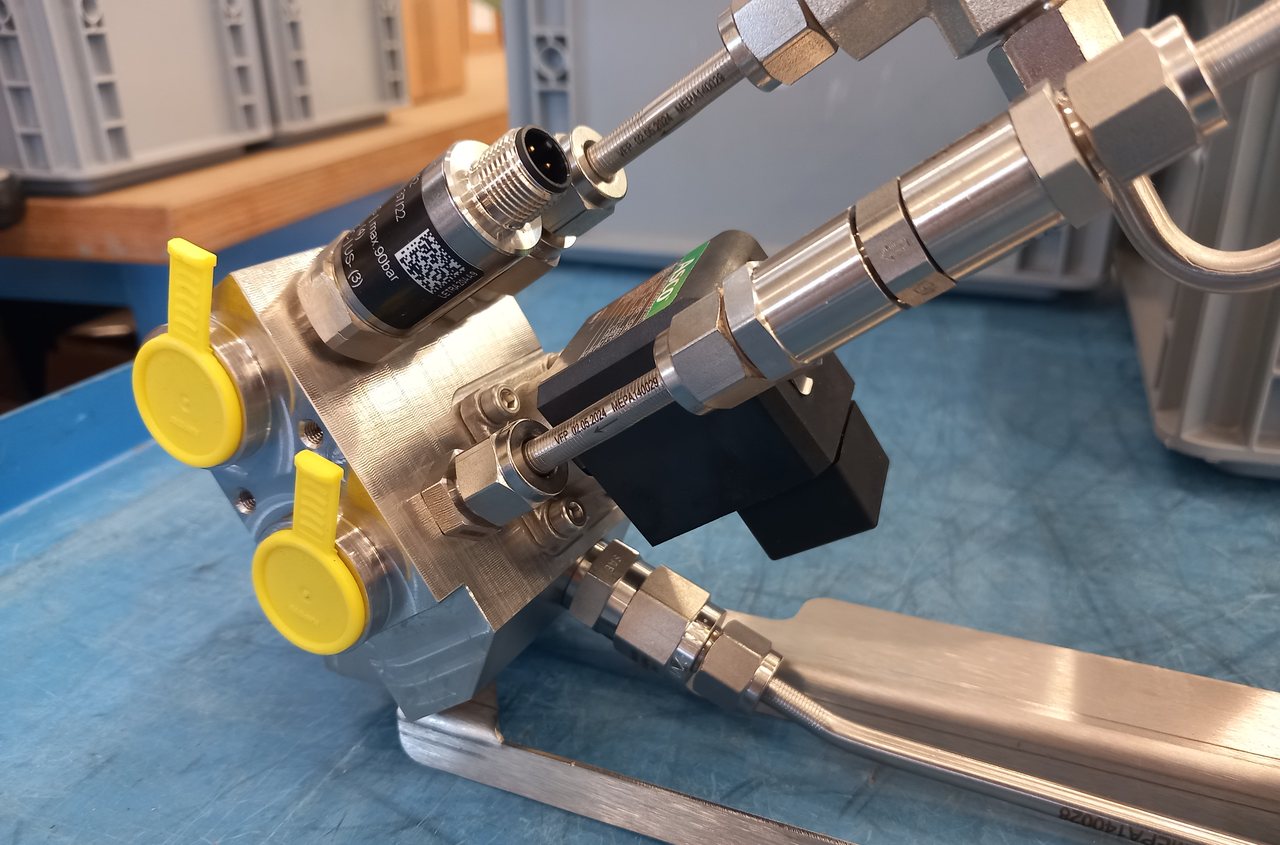
Gas block close-up — CNC manifold body with pressure sensor, solenoid valve, and stainless fittings. Precision fluid engineering in a compact assembly.
Photo: Ralph Caldecott
How making a safety-critical subsystem supplier-agnostic drove a 35% cost reduction — and why procurement strategy is an engineering discipline.
When a hydrogen electrolyser company decided to redesign their single-core electrolyser for mass production, every subsystem needed to be rethought — not just for performance, but for manufacturability, cost, testability, and supply chain resilience at scale.
The gas block is a safety-critical subsystem at the heart of the electrolyser. It takes hydrogen directly from the stack and manages everything that happens to it before it leaves the unit: filtering aerosol water and chemical impurities from the gas stream, regulating upstream stack pressure, and providing multiple independent layers of safety protection against dangerous pressure excursions.
In the original design, this system was assembled inside the electrolyser frame — component costs alone exceeded the eventual target for the fully assembled, tested, and delivered subsystem. The brief was clear: redesign for mass production, reduce cost, improve performance, and make it manufacturable and testable as a standalone modular unit.
The modular architecture and supplier competition strategy were not part of the original brief — both emerged from the engineering process itself. The decision to make the subsystem fully testable as a standalone unit before it ever reached the production line, and to structure the component specification to allow genuine supplier competition, were defining choices that shaped everything that followed.
The gas block was redesigned as a self-contained modular unit — fully assembled, leak tested, and validated by the supplier before delivery. On the production line, installation is a single clip-in operation.
The gas management system handles the full hydrogen conditioning sequence in a compact package:
The design was made deliberately agnostic to component supplier — fittings, tubing, sensors, and CNC parts were all specified to allow multiple suppliers to compete for the mass production contract. Two suppliers — Voss and Serto, both established industrial fluid system specialists — were selected for the initial production period to maintain competitive pressure and dual-source security. A single final supplier was selected based on long-term performance and consolidation efficiencies.
Pass/fail leak test thresholds were established through a dedicated experimental campaign conducted in collaboration with Pfeiffer Vacuum. Those thresholds remain in use today.
A significant part of the development work involved evaluating and proving sealing solutions across the full range of technologies used in the subsystem — elastomer selection, O-ring groove geometry and compression ratios, ferrule types, valve technologies, fitting interfaces, and surface finish requirements. Because the same engineer was responsible for both the mechanical design and the leak test characterisation, it was possible to design, test, prove, and iterate sealing solutions in a tight loop that would not have been possible if design and test were separate teams. The result is a subsystem where every sealing interface has been validated under real operating conditions and production volumes, not just specified to a standard.
The most underrated engineering skill is knowing how to use a procurement process as a design tool. Making the subsystem supplier-agnostic wasn't just good engineering practice — it created real commercial leverage. Suppliers who know they can be replaced perform differently from those who know they can't. The price reductions were significant, but the improvement in supplier focus and quality commitment was equally valuable and harder to quantify. Good design and good procurement strategy are not separate disciplines.