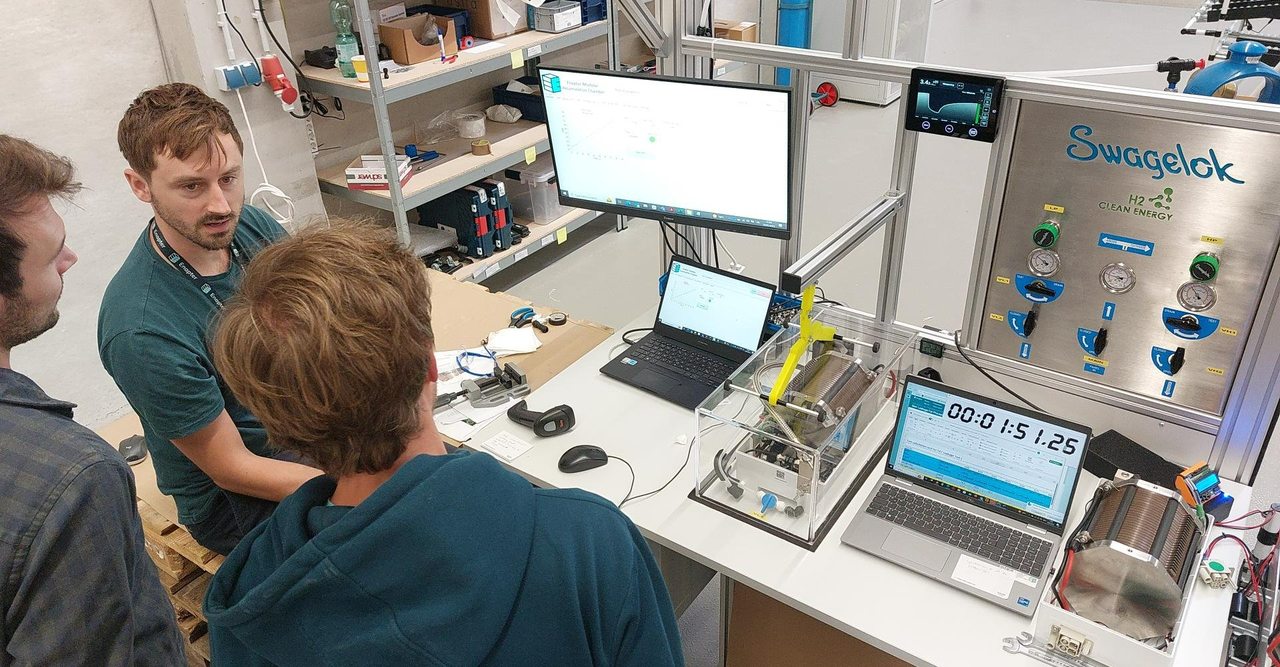
Early development — reviewing the accumulation chamber software with colleagues. The prototype chamber and test timer are visible on the bench.
Photo: Ralph Caldecott
Replacing manual gas sniffers with an automated integral leak test system — and the engineering judgement behind choosing the right level of precision.
Every electrolyser stack leaving production needed to be leak tested before deployment. The existing method used portable combustible gas sniffer probes — a manual, labour-intensive process with three compounding weaknesses: it was slow, it was dependent on operator technique, and the sensors themselves had known accuracy and reproducibility limitations.
Critically, a sniffer probe is a local measurement — it detects leaks only where the operator points it. A stack could pass a manual test and still have a diffuse leak that no single probe position would catch. For a hydrogen-producing device, the consequences of a leak reaching the field are serious. A more rigorous, traceable, and scalable solution was needed.
The accumulation chamber method is a well-established leak testing technique, but implementing it correctly for this application required careful engineering judgement — particularly in selecting the right detection technology and establishing meaningful pass/fail thresholds.
The system works by placing a purpose-built chamber over the stack, pressurising it internally to its test pressure, and connecting the chamber volume to a Pfeiffer vacuum mass spectrometer. Using forming gas as the tracer, any leak accumulates within the known chamber volume and is quantified by the mass spectrometer — giving a true integral leak rate for the entire stack in a single measurement, not a local reading from one point.
The choice of accumulation rather than vacuum chamber was deliberate. Vacuum chambers offer detection down to 10⁻⁹ mbar·L/s, but the application's pass/fail threshold sits well above the 10⁻⁵ to 10⁻⁶ mbar·L/s resolution of the accumulation method — making vacuum-level sensitivity unnecessary and the associated cost and complexity unjustifiable. The right tool for the job, not the most impressive one.
Pass/fail thresholds were established through a dedicated experimental campaign prior to production deployment, conducted in collaboration with Pfeiffer Vacuum. The system is calibrated daily against a traceable reference leak. The operator loads the stack, closes the chamber, and starts the software — the system handles the full test sequence, calculates the integral leak rate, applies the threshold, and logs the result directly to the MES. Every test is traceable. Every result is documented.
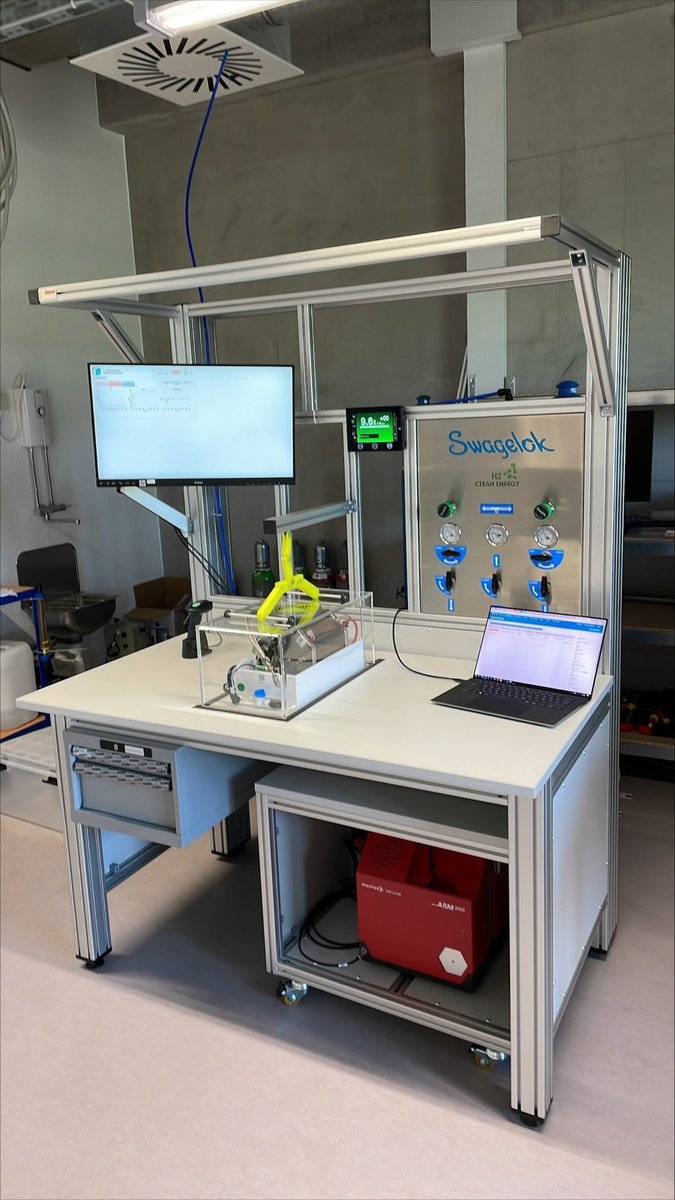
The final system is a self-contained mobile workstation — aluminium profile frame, integrated lighting, dedicated test bench surface, and all gas handling and control hardware mounted within the footprint. The Pfeiffer ASM 800 mass spectrometer sits beneath the bench, connected to the accumulation chamber via flexible vacuum line.
The Swagelok H2 Clean Energy gas panel on the right provides the forming gas supply at regulated pressure. The test software runs on a laptop docked to the station — every result logged automatically, every test traceable to a reference leak calibrated that shift.
The most important decision on this project wasn't technical — it was knowing what level of performance was actually needed. Vacuum chamber leak testing is more sensitive by several orders of magnitude, but sensitivity beyond the application requirement adds cost, complexity, and cycle time with no benefit. Engineering judgement means knowing when good enough is genuinely good enough, and being able to defend that choice with data.